

Events
Sponsors
















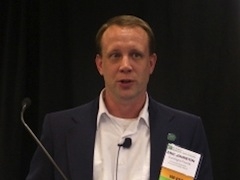 |
Eric Johnston - ConAgra Foods
PDF document
published on 19 June 2013
Eric Johnston, Principal Engineer at ConAgra Foods, Inc., provided a brief introduction to the company and its products. He spoke about ConAgra Foods' experience with anhydrous ammonia, which is employed in 27 of the company's 38 plants with significant refrigeration systems, emphasising that with proper handling, operating and maintaining, ammonia refrigeration systems are just as safe as any other refrigerant system.
view presentation
 |
Gerard Von Dohlen - No Refrigerant is good - Less is more
PDF document
published on 19 June 2013
Gerard Von Dohlen, CEO of Port Newark Refrigerated Warehouse, outlined the history of ammonia as a refrigerant and its development from before 1930 to today. He compared R22 to ammonia, concluding that ammonia, which is cheaper, more efficient and environmentally friendly, is the best industrial refrigerant. Von Dohlen also mentions the challenges of using ammonia, including regulatory issues.
view presentation
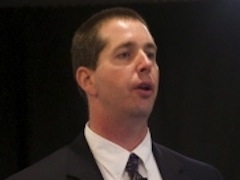 |
Michael A. Chapman - Preparedness is Knowing what to do BEFORE the clock starts ticking
PDF document
published on 19 June 2013
In his presentation about the use of industrial ammonia refrigeration at Tyson Foods Inc., Michael Chapman emphasized the importance of preparedness when operating an ammonia system. Chapman outlines how ammonia systems are safely operable, as long as there is a trained team and incident commander on hand, who know how to respond when there is an issue.
view presentation
 |
Eric Smith - Industrial Refrigeration and the IIAR
PDF document
published on 19 June 2013
In his introduction to the industrial end user panel discussion, Eric Smith provided an overview of the activities of the Internation Institute of Ammonia (IIAR), which provides advocacy, education, standards and information for the benefit of the ammonia refrigeration industry.
view presentation
Technology Case Study Session 2 |
 |
 |
Jim Hower, Benoit Rodier - Ammonia/CO2 system offers mainstream solution
PDF document
published on 19 June 2013
Danfoss and Cimco Refrigeration present a case study involving Canadawide, and deploying a unique ammonia/CO2 refrigeration solution for the expansion of a 60,000 ft2 distribution center/warehouse, in Montreal, Canada. The installation lead to savings in energy, installation costs, and maintenance.
view presentation
 |
Derek Hamilton - Low charge ammonia condensing units for the US market
PDF document
published on 19 June 2013
In his presentation, Derek Hamilton demonstrates how lower installation costs, better efficiency, and lower operational costs can be achieved by using the latest aluminum heat exchanger technology coupled with low-pressure receiver systems. This results in high efficiency ammonia systems with a minimal ammonia inventory.
view presentation
 |
John Hipchen - Developing low charge R290 room air conditioners using smaller diameter copper tubes
PDF document
published on 19 June 2013
In his presentation, John Hipchen provides information and technical guidance on how to decrease the refrigerant charge of an air conditioner (AC) when using smaller diameter and inner-grooved copper. Based on experiences in China, the presentation also shows examples of R290 AC implementation in North America and gives insights into current development work in China with R290.
view presentation
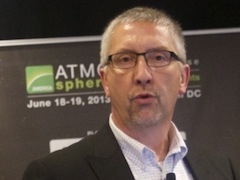 |
Brian Porter - CO2 double stage trans-critical compressors: making CO2 equipments reliable, affordable and more efficient
PDF document
published on 19 June 2013
Brian Porter presents a two stage internally compounded transcritical CO2 compressor range which results in both cost and energy efficiency savings, while also ensuring safer equipment. Furthermore, the presentation discusses the UL approval procedure for high-pressure equipment and highlights examples of end users using the product in different applications.
view presentation
 |
 |
Preston P. Blay, Ilana Cember - The refrigeration condenser: how the different types affect energy consumption and system performance
PDF document
published on 19 June 2013
This presentation compares air-cooled, evaporative and hybrid condensers in terms of first costs and operating costs, looking at peak demand in kW, total energy use in kWh, and water use. Additional condenser options are presented as well as carbon footprint savings from reduced refrigerant charge and electricity savings.
view presentation